
Unpacking the advantages of textile air dispersion systems in HVAC. This is Part 4 of a four-part series.
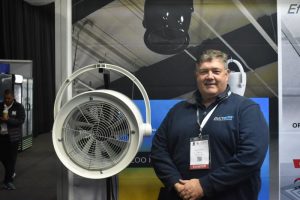
Nico Koegelenberg, managing director of DuctSox, recently shed light on the potential of textile air dispersion systems as a superior alternative to traditional metal ducting and diffusers. His technical talk at SAIRAC Cape Town highlighted significant cost savings, enhanced efficiency and a range of practical benefits that are reshaping how we think about air distribution.
Koegelenberg also highlighted the full retention systems, which feature an internal skeleton to keep the system fully inflated, offering a 20-year warranty. These systems are aesthetically pleasing, especially for offices, and are suspended from the building’s metal structure, not the textile itself. He cited impressive examples of their global application, including the 72 000-seat Raiders Stadium in Las Vegas, where a single textile air dispersion system runs the full perimeter at the top, covering the entire stadium with a two-pitch throw.
Further demonstrating their widespread use, Koegelenberg mentioned underfloor air dispersion (UFAD) systems in high-rises like the 118-story Merdeka 118 in Malaysia (82 floors use textile UFAD) and the Burj Khalifa in Dubai, the world’s tallest building. These applications illustrate how textile systems simplify high-rise construction by allowing each floor to be its own plenum, eliminating the need for large central ducting columns.
Maintenance of textile systems is remarkably simple. They can be easily removed (connected by low-seepage zippers in sections, similar to a diving suit) and washed in a washing machine, then air-dried and folded for storage. This ease of cleaning and transport (they come in boxes and can be flown to site) is a significant advantage, particularly for critical environments like food processing, where companies often keep a second system to ensure no downtime during cleaning cycles. “As long as the system runs, it’s clean,” Koegelenberg noted, adding that proper filter maintenance should prevent the system from getting dirty.
Heat loss in textile systems is minimal because the fabric is not a conveyor of energy, making it more efficient than insulated metal ducting, which can experience heat gain due to friction at diffusers. The porosity of the fabric also prevents dust buildup and condensation. For clean rooms and hospitals, specific ISO 5 textiles are used, designed to be non-shedding and anti-static.
Question and answer session
“One of the biggest challenges,” Koegelenberg acknowledged, “is educating consulting engineers. Textile air dispersion isn’t part of the typical engineering curriculum—underfloor air systems might be, but not this as an alternative to metal ducting and diffusers. That gap in education makes it hard to get experienced professionals to think outside the box.”
Still, he remains optimistic: “Younger engineers are more open to trying new ideas, and once clients try textile systems, the benefits often speak for themselves: I’ve had customers who never went back after their first install because of how easy it is.”
He noted their specialisation in demanding environments like food processing, agriculture and clean rooms. There is no practical limit to the length of the design, with systems installed up to 120m with bends. Even pressure loss across elbows is managed by AFDs installed just after the bend, factory-set to maintain consistent pressure.
While continuous pressure monitoring isn’t typically required, Koegelenberg noted that performance issues (like reduced airflow or throws) would indicate a problem, likely due to dirty filters rather than the system itself. He reiterated that the AFDs are hidden inside the system, factory-set, and require no on-site adjustment.