
Unpacking the advantages of textile air dispersion systems in HVAC. This is Part 3 of a four-part series.
Nico Koegelenberg, managing director of DuctSox, recently shed light on the potential of textile air dispersion systems as a superior alternative to traditional metal ducting and diffusers. His technical talk at SAIRAC Cape Town highlighted significant cost savings, enhanced efficiency and a range of practical benefits that are reshaping how we think about air distribution.
Suspension systems vary from single cable/track for smaller diameters to multi-row systems for larger ones, ensuring proper inflation and aesthetics. Retention systems, using internal hoops or full tensioning with an internal skeleton, are available for applications where a deflated appearance is undesirable, particularly in office spaces.
Connections are remarkably simple, utilising zippers similar to a diving suit, allowing for easy handling and replacement of individual sections if damaged. Connecting to the main inlet or fan requires a metal spigot and a duct belt, which tightens over the metal sleeve. “That’s it, that’s all you need to do,” Koegelenberg confirmed, highlighting the minimal on-site work.
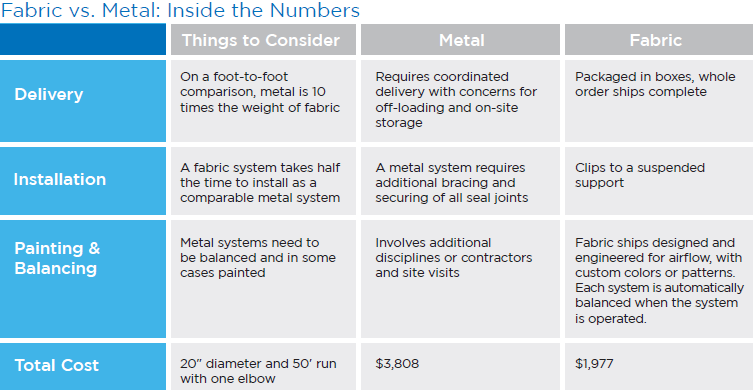
Comparing a textile system to a traditional metal duct system (which requires ducting, diffusers, dampers, suspension, balancing and painting, often without including insulation), Koegelenberg presented compelling cost data: “The textile ducting was 40% cheaper than the metal. The installation cost was 80% less.”
Finally, Koegelenberg stressed the importance of code compliance. Certified textile systems adhere to UL 2518 and NFPA 90A standards, covering surface burning characteristics, molten drip, erosion, temperature and pressure. These systems are certified to operate between -30°C and 140°C. While South Africa’s SANS standards do not yet have a specific code for textile systems, consulting engineers typically refer to British Standards for design and specification.
Design fundamentals and advanced features
Beyond initial cost savings, textile systems also offer extended longevity. “Unlike metal, you can get up to 20-year warranties on a textile system, which you wouldn’t get with metal,” Koegelenberg highlighted.
“For optimal performance, certain design fundamentals must be met. The inlet static pressure is critical—ideally 124 Pascals, and never below 65 Pascals—as this pressure inflates the non-rigid textile system. While 65 Pascals may result in minor wrinkling, the system can tolerate up to 750 Pascals, and even higher pressures with factory consultation. Air volume is also essential, as it determines the system diameter, much like metal ductwork. In noise-sensitive environments such as churches, inlet velocities are limited to a maximum of 5.1 meters per second. However, straight systems can operate up to 8.1 meters per second, and full retention systems up to 10.2 meters per second—each maintaining full warranty coverage.
“Textile systems do not require on-site balancing thanks to internal Air Flow Devices (AFDs), which are factory-set to manage airflow and pressure drop. This ensures consistent pressure throughout the system, allowing for long, uninterrupted runs of textile ducting without size reductions, and minimising the ‘pop effect’ often heard at system start-up.”
Koegelenberg suggests that textile systems exhibit a significantly lower friction drop (around 35%) compared to metal (60-70%), primarily due to the smooth fabric and cylindrical shape. This, combined with static regain (where pressure is recovered as the system inflates from the end cap backwards), allows for uniform air dispersion over lengths up to 100m, depending on porosity and inlet static pressure.
Ventilation is precisely engineered and laser-cut onto the system, allowing for specific velocity requirements and flexible vent locations. “Ventilation can be anywhere on that system and at different positions,” Koegelenberg explained, noting that throws of 20-30 meters are achievable when designed correctly. This granular control ensures uniform comfort throughout the space, even in complex layouts like gyms, eliminating “hot and cold spots.”
Regarding noise, different textile configurations (porous fabric with orifices, fixed nozzles, linear vents, adjustable nozzles) have varying noise profiles. Only adjustable nozzles tend to be louder than metal diffusers, while other textile dispersion methods are quieter. The inherent flexibility of textile allows for much simpler designs compared to metal, often replacing complex branches and T-offs with a single textile run that disperses air evenly. Any fitting achievable in metal, such as transitions or elevation changes, can also be custom-built in textile.