
By Eamonn Ryan, with technical input from Shaun Hadfield, director: Future Green Now (FGN). Sysco’s major cold‑storage facility in Modesto, California, has undergone a comprehensive retrofit from an ageing freon plant to a high‑efficiency CO2 system, managed from South Africa. A live retrofit in a demanding environment. Working in a live warehouse with no interruption to trading, CO₂ Refrigeration Systems (CRS), Future Green Now (FGN) and IHG Mechanical delivered a fully integrated skid‑based solution that boosts capacity, sharpens temperature control and positions the site for California’s demanding environmental regime.

In Modesto, a key agricultural hub in California’s Central Valley, Sysco operates a major cold storage and food distribution facility serving a broad base of restaurant and food‑service customers. When rising throughput began to push the limits of the site’s existing freon‑based plant, and environmental regulations tightened around high‑GWP refrigerants, Sysco made the decision to invest in a comprehensive refrigeration upgrade. The result is a technically sophisticated CO₂ retrofit that increased capacity, improved efficiency and aligned the operation with California’s green objectives – without interrupting daily trading. The project brought together several specialist players. Sysco is the end user and owner of the facility. CRS in the US manufactured the CO₂ rack, or skid, and acted as the named supplier to Sysco. IHG Mechanical was appointed as the local refrigeration contractor responsible for installation and on‑site work. FGN, an international refrigeration consultancy engineering firm, provided the detailed design for the rack, coils and piping, and took the lead on start‑up and commissioning support. Although FGN has a US branch, this project was largely run out of its South African office, underscoring the global collaboration behind the plant.
This was not a greenfield build. Sysco already operated a working cold store on the site, built around a conventional freon system. The layout comprised three principal zones: a dock‑levelling and loading area for inbound and outbound product, a main freezer room, and a dedicated ice-cream freezer room. Completely shutting the facility to replace the plant was never an option. The overriding requirement was to maintain trading at all times, with stock continuing to move in and out of the warehouse. This condition shaped the entire project from the outset. At a technical level, the brief to FGN and CRS was straightforward to state but complex to realise. Sysco wanted to increase cooling capacity, improve energy efficiency, and move to a more sustainable, natural‑refrigerant solution. The system had to serve three distinct temperature zones with appropriate capacity and control. The ice‑cream freezer room operates at around -25°C, the main freezer room at approximately -20°C, and the dock area – functioning as the in‑ and outbound receiving section – between 0 and 2°C. To meet these needs, the new plant was engineered with a low‑temperature capacity of roughly 56kW and a medium‑temperature capacity in the region of 300kW. Dorin CD 335 1B compressors were selected for the low‑temperature side, and Dorin CD 501M compressors for the medium‑temperature duty. On the refrigerant side, the practical choices at this scale were ammonia or CO₂. Given the size and configuration of the site, and the particularities of Californian policy and environmental codes – alongside the global phase‑down of high‑GWP gases – CO₂ emerged as the more appropriate option. It offered a natural, low‑GWP refrigerant with excellent performance, without the additional complexities that an ammonia solution would have introduced for this particular facility.
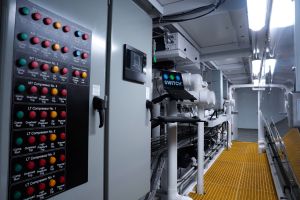
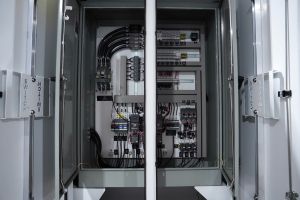
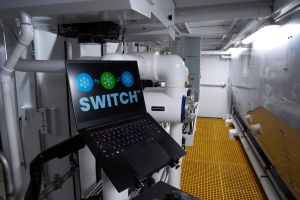
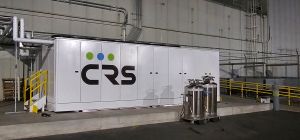
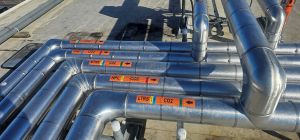
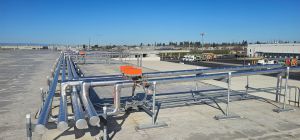
Serviceability formed another crucial part of the brief. Sysco wanted reassurance that once the plant was commissioned, there would be competent local support for day‑to‑day operation and maintenance. IHG Mechanical’s background was primarily in ammonia and freon, and this was their first CO₂ project. The design therefore needed to lend itself to training and straightforward servicing, with clear component layouts and a coherent control philosophy. The heart of the installation is a factory‑built CO₂ rack supplied by CRS. In North American terminology this is a ‘skid’, but effectively it functions as a complete plant room in a single IP65‑rated enclosure. All major mechanical and electrical components – compressors, oil management, gas cooler, vessels, controls and switchgear – are integrated inside the skid. One of CRS’s distinctive features is its ‘Switch’ concept: the enclosure has robust doors that can be opened like normal cabinet doors or removed completely and parked to one side, giving excellent access for installation and maintenance. The doors are re‑fitted, they align cleanly, preserving the unit’s integrity and weather protection. The aim is a true drop‑in solution: crane it into place, connect services and commission. Within the skid, Dorin compressors carry out the compression work for both the medium‑ and low‑temperature suction groups. Oil separation and management are handled by a Temp‑Rite oil system, well suited to CO₂’s higher pressures. Oil filters, separators and regulators are arranged for easy monitoring, with pressure gauges and transducers positioned where commissioning and service engineers can readily see them. On the high‑pressure side, the plant uses a gas cooler rather than a traditional condenser. This is standard practice for CO₂ systems: instead of condensing the refrigerant in the conventional sense, the gas cooler reduces the temperature of the high‑pressure gas. Pressures of the order of 80–90 bar on the high side are dropped to about 38 bar by a high‑pressure valve into a separation vessel. Its main function is to separate the liquid and vapour portions after the pressure reduction. To secure efficient operation in California’s often high ambient temperatures, CRS integrated an adiabatic gas cooler. Wet pads on the sides of the cooler are supplied with water so that incoming air is pre‑cooled by evaporation before it passes through the heat‑exchange coil. This reduces gas cooler outlet temperature under hot conditions and supports stable operation and good efficiency when the ambient soars. From the skid, stainless‑steel piping distributes refrigerant to the various cold rooms. Each evaporator circuit is served by four key lines: a liquid line, a suction line, a hot‑gas line for defrost and a hot‑gas return line. On the roof, valve stations with actuated valves manage the mode of operation. In normal cooling, the expansion device and suction line are open while the hot‑gas lines are closed. During defrost, the hot‑gas and hot‑gas return lines are opened and the cooling path is isolated. These valve stations are mounted on a soft, protective surface on the roof, with vertical drops into the relevant rooms below. The evaporators themselves were supplied by Colmac. The dock‑levelling area and both freezer rooms use Colmac air coolers designed for the respective temperature levels, all equipped with hot‑gas defrost.
Electrical panels mounted on the front of the evaporators house sensors and local control hardware, and provide a convenient point from which to inspect coil condition and frost build‑up. Controls were standardised on Danfoss hardware. A Danfoss rack controller – specifically, the Danfoss 880 system – manages the skid, while individual controllers at the evaporators regulate superheat and defrost cycles. Danfoss transducers and valves are used throughout for pressure and flow control, giving a coherent controls platform from rack to room. One of the more notable control choices was the specification of stepper‑motor expansion valves on the evaporators. The existing freon system had used a far simpler arrangement: essentially a thermostatic expansion valve controlling flow based on a bulb temperature, with a solenoid on/off function. That approach tends to give relatively coarse temperature control and wider swings in room conditions. By contrast, the new system’s stepper‑motor valves can modulate continuously across the full load range. Where a conventional electronic expansion valve might be adequate for smaller coils, the size and capacity of the Modesto evaporators made stepper motors more suitable, allowing control from effectively zero up to around 50kW on a single coil if required. This fine modulation is central to the system’s improved stability and contributes directly to its energy performance. If the engineering concept was straightforward, implementing it in a live, working warehouse was less so. The critical challenge was to integrate the new plant while keeping Sysco trading. To achieve this, the project team adopted a staged retrofit. Portions of the existing freon system were shut down and decommissioned in turn, while new CO₂ evaporators and piping were installed and brought on line. At each stage, careful co-ordination was required to ensure that product temperatures remained within acceptable limits and that there was always sufficient capacity available. IHG Mechanical’s limited prior experience with CO₂ meant that training became a parallel workstream. Although the contractor was highly capable with ammonia and freon, CO₂ presented new considerations: higher pressures, different charging practices, transducer‑based control philosophies and the specific demands of hot‑gas defrost in low‑temperature CO₂ rooms. FGN played a hands‑on role during installation and commissioning, guiding IHG’s team through these differences and using any issues that arose as learning opportunities. Some of those issues were extremely practical. Incorrectly installed probes and blockages in evaporators were picked up and rectified during commissioning. Another striking example concerned refrigerant charging. In California, a specialist gas supplier is typically brought in to charge the system using a practice wholly at odds with accepted CO₂ charging procedures. The commissioning engineer intervened, documented the incident and used it to reinforce the need for proper techniques when handling high‑pressure CO₂. Despite these challenges, there were no fundamental design flaws. The CRS skid performed as intended, the piping arrangement was logical and accessible, and the control philosophy was robust. The main obstacles were human: learning a new technology, adjusting old habits and paying close attention to detail. With training, on‑site support and iterative troubleshooting, the team successfully brought the system into line with the original specification. Once the plant was up and running, its impact on energy performance became apparent: energy savings of around 20–28% were observed under typical conditions, with improvements reaching up to approximately 45% depending on ambient and operating circumstances. The exact figure fluctuates with weather and loading, but the CO₂ system is substantially more efficient than the freon plant it replaced. Several factors underpin this gain: CO₂’s favourable thermodynamic characteristics at the required temperatures, the adiabatic gas cooler’s ability to manage high ambients, and the shift to fully electronic, finely modulated control at the evaporators. The transition from a simple solenoid‑and‑bulb arrangement to stepper‑motor valves and integrated Danfoss controls has sharpened temperature control dramatically. Sysco’s own feedback reflects this. The client commented on a noticeably “crisper” feeling in the freezer and dock areas, and on the system’s ability to pull down temperatures quickly and hold them with little deviation. From a sustainability standpoint, the shift to CO₂ also eliminates the long‑term risk associated with high‑GWP refrigerants. California is known for its strong environmental stance, and aligning the Modesto facility with natural refrigerants positions Sysco well for future regulatory developments as well as present‑day corporate environmental commitments. What makes the Sysco Modesto project stand out is not a single headline feature, but the combination of elements. It was not new technology but was new to the client. It is a technically well‑resolved CO₂ retrofit executed in a live, high‑throughput facility. It leveraged a modular, factory‑built skid from CRS, integrated with carefully designed roof‑mounted valve stations and stainless‑steel distribution piping. It required the upskilling of a capable but CO₂‑new contractor, supported on site by FGN. It delivered measurable energy and performance gains and has left Sysco with a plant that is both more efficient and more future‑proof. More broadly, it demonstrates how expertise from markets that are further advanced in CO₂ – South Africa and Europe, in this case – can be transferred effectively into North America. In many respects these regions are years ahead in natural refrigerant adoption. Projects like Modesto are helping to close that gap, creating local competence and proving in practice that CO₂ systems can be designed, installed and supported successfully in demanding commercial cold‑storage applications. For Sysco, the benefits are already being realised: increased capacity, improved control, reduced energy use and a clear step forward on the sustainability journey, all achieved without ever having to stop the trucks at the dock.