
By Eamonn Ryan
At the GCCA Africa cold chain conference, Edison Machedi, deputy director of Agriculture and commandant in the Border Management Authority (BMA), presented the BMA’s evolving role in risk management and law enforcement at South Africa’s borders.
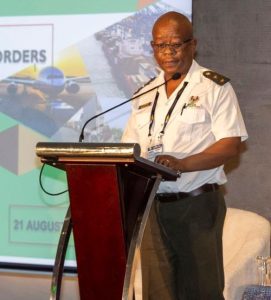
He emphasised the need for an integrated approach to border security, the adoption of modern technologies and a balance between biosecurity and trade facilitation.
The BMA was formally established in 2023, following a multi-year legislative and organisational process dating back to 2009. It was created to integrate multiple border control functions – immigration, agriculture, port health and environmental compliance – previously handled by separate entities.
BMA is South Africa’s third armed service, after the SAPS and SANDF, as established under section 199 of the Constitution.
The BMA is the sole competent authority within the border law enforcement area, with a single chain of command and control. The Act defines the land border law enforcement area as 10km inward from any land border and similarly for maritime borders. However, this excludes airports, which are classified as ports of entry, not border law enforcement areas.
There are ongoing legal discussions to clarify and possibly expand the operational scope, particularly regarding facilities outside the defined zones.
- Roles and responsibilities:
- Provides integrated law enforcement at ports of entry
- Enhances resource optimisation, risk- based operations, and information sharing with entities like SAPS, SANDF and neighbouring countries
- Implements policy prescriptions from parent departments (for example, Department of Agriculture)
- Operates under formal service level agreements defined in Section 97 proclamations
- Reports to multi-agency structures, including the Inter-Ministerial Consultative Committee (IMCC)
Border risk management is conducted in three stages:
- Pre-border: risk assessments from country of origin, including early warning systems
- At the border: inspection, sampling and control measures based on identified risks
- Post-border: monitoring and mitigation after entry
These processes support Sanitary and Phytosanitary (SPS) Compliance and align with global best practices for food safety and public health.
Examples of global risk- based sampling systems
US model: risk-based sampling starts at 12% inspection rate; failure increases inspection frequency (up to 100%), while success reduces it.
Australia model: Similar tiered system where frequency is adjusted based on compliance history and product category (for example, surveillance food vs compliance agreement food).
The BMA is modernising inspection and permitting systems to reduce trader burden and improve compliance.
Key tools include:
- ESET system: electronic issuance of import permits and phytosanitary certificates
- Customs integration: BMA systems are interfaced with customs platforms for real-time tracking, inspection decisions and document verification
- Dashboards and automated workflows: streamline decision- making and minimise paper-based processes
Current challenges: recent outbreaks – FMD, African Swine Fever, and Tomato Leaf Curl New Delhi Virus – highlight gaps in surveillance and response.
Recommendations:
- Investment in trained personnel at ports of entry
- Enhanced cross-sector collaboration between government, academia and industry
- Establishment of a National Biosecurity Hub to unify interventions and improve SPS outcomes
Machedi emphasised that while AI and technology will play a critical role, they are not substitutes for trained human personnel. Surveillance and risk mitigation must be approached holistically, balancing trade facilitation with public health and environmental protection.
Register for free to gain access the digital library for Cold Link Africa publications