
By Eamonn Ryan
On a recent Apple podcast on From The Cold Corner platform, host Kelley Rodriguez welcomed David Campbell and Jeremy Kynsen of Burns & McDonnell to discuss a question that’s quietly redefining the cold chain: not whether to automate, but how far to take it. This is part two of a two-part series.
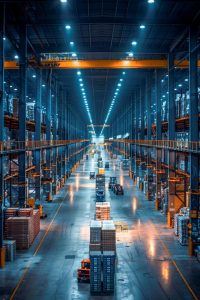
If robotics represent the visible face of automation, simulation and artificial intelligence form its analytical backbone. One of the quiet revolutions in modern warehouse design is the rise of advanced modeling tools. In the past, system validation often relied on spreadsheet calculations that projected throughput under ideal conditions. But spreadsheets rarely capture the outliers – the rare demand spikes or operational disruptions that create disproportionate stress.
Today, digital simulation allows operators to model complete operational profiles before construction begins. SKU movements, seasonal surges, maintenance interruptions and peak-day volumes can all be tested virtually. By stress-testing systems in advance, companies dramatically reduce implementation risk and shift discussions from assumption to evidence.
Artificial intelligence extends well beyond robot navigation. Predictive maintenance platforms now monitor vibration, motor loads and temperature patterns to identify anomalies before failures occur. In temperature-controlled environments, where downtime can compromise both product and reputation, this foresight is invaluable. AI-driven analytics also refine slotting strategies, dynamically positioning fast-moving SKUs closer to pick points and adjusting layouts as demand patterns shift. Automation becomes less about replacing labour and more about enhancing operational intelligence.
Yet even the most advanced systems remain bound by physical realities. High-density automation increases electrical demand and compresses motors, charging stations, conveyors and refrigeration equipment into tighter footprints. Slab capacity, ceiling height, sprinkler design and airflow must all align with the automation profile. Technology choices made without regard to infrastructure can quickly erode projected returns.
Equally critical is organisational readiness. Advanced automation requires skilled maintenance, disciplined processes, and long-term support. Campbell likened the distinction to maintaining a commuter vehicle versus servicing an IndyCar. Precision systems demand specialised expertise. Recognising this, many integrators now provide resident maintenance programmes to ensure reliability long after commissioning.
Automation is not a plug-and-play investment. It is an operational transformation.
Cold storage operators face mounting pressure from labour volatility, energy costs, food safety scrutiny and fluctuating consumer demand. In that environment, automation is increasingly central to competitive strategy. But maturity does not mean simplicity. The most successful projects are not the most aggressive; they are the most aligned – with throughput realities, capital discipline, infrastructure capacity and long-term business goals.
The warehouse of the future will not be defined by height or robot count alone. It will be defined by how effectively intelligence, infrastructure and human capability are integrated. In the cold chain, adaptability is no longer optional. It is the advantage that determines who leads and who follows.