
By Eamonn Ryan
In fire science, almost everyone learns the fire triangle early on: fuel, heat and oxygen.
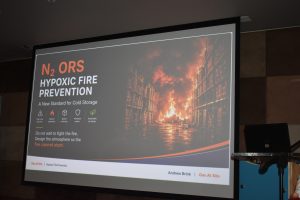
© Cold Link Africa
Traditional fire protection strategies in warehouses and cold stores tend to focus on controlling heat and fuel after the fact – detecting a fire once it has started, then suppressing it with water, mist, foam or inert gases. As Andrew Brink of Gas At Site pointed out, that mindset is fundamentally reactive.
Hypoxic fire prevention reframes the challenge. Instead of asking, “How do we put the fire out quickly?”, it asks, “How do we prevent the fire from igniting at all?” The answer is to tackle the oxygen leg of the triangle continuously.
“If we reduce the oxygen… from 21% down to 15% a fire will not start, there’s not enough oxygen to start a fire, a flame,” said Brink.
This is more than a marginal tweak. At around 21% oxygen (normal air), many common packaging materials, plastics and structural products can ignite quickly once sufficient heat is present. By lowering the oxygen level to about 15%, you move below the ignition threshold for a huge range of materials. Sparks, hotspots and even open flames struggle to achieve sustained combustion.
Crucially, this is still an environment in which people can safely function. Brink stressed that the system is designed around established exposure specifications and standards. For workers such as forklift operators and warehouse staff moving in and out of the protected area: “The spec allows eight hours, then a break of ten minutes after four hours, and then back for another four hours… You don’t want to have an office with office workers working nine to five in a low oxygen environment, but forklift operators moving in and out of the warehouse, no problem at all.”
The result is a unique combination: an atmosphere in which fires cannot gain a foothold, yet operations can continue. Unlike gas‑release suppression systems that trigger only during a fire event, hypoxic prevention is always on, silently holding oxygen below the critical threshold.
In Part 3, we zoom in on what this means for the cold chain specifically – from avoiding six‑month outages to supporting automated, high‑density warehouses.