
By Eamonn Ryan
If the hatchery is where life begins, the conveyor belt is where reality delivers its first cold, hard correction.
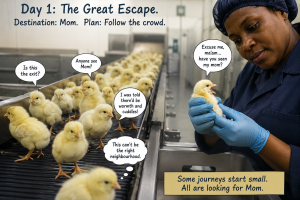
In this scene from modern poultry logistics, newly hatched chicks are ushered out of incubation bliss and onto a conveyor system that hums with industrial precision. Moments earlier they were enjoying a carefully controlled environment of warmth, humidity, and rhythmic comfort. Now, they find themselves under bright lights, gentle airflow, and the unmistakable sensation that someone has ‘upgraded’ the room temperature without asking for consent.
One chick, still slightly damp and emotionally unprepared, tilts its head and asks, “Is this the exit?” Another, standing uncertainly on the moving belt as if it might suddenly introduce itself, calls out, “Anyone seen Mom?” A third, visibly outraged by the lack of immediate cuddles, protests: “I was told there’d be warmth and cuddles!”
A fourth, with the weary resignation of someone already rethinking life choices, mutters: “This can’t be the right neighbourhood.”
From a cold chain perspective, of course, everything is working exactly as intended.
Behind the scenes, the hatchery environment is a masterclass in temperature-controlled logistics. Incubation systems have maintained precise thermal conditions for development. Now, post-hatch handling systems take over with equal discipline: controlled airflow, calibrated ambient temperatures and hygienic separation protocols designed to ensure flock health and biosecurity. It is not chaos – it is engineered continuity.
But try telling that to a chick experiencing its first encounter with industrial refrigeration principles.
Overhead, air handling units quietly maintain optimal conditions, ensuring the transition from incubation to transport is smooth. To the chicks, however, it feels suspiciously like someone has left a door open to ‘mildly confused winter’.
One particularly energetic chick attempts what can only be described as a protest flap, running in place as the conveyor carries it forward. “I object to this logistics model!” it appears to declare, though this may be misinterpretation due to the squeaking.
A supervisor might call it ‘efficient throughput’. The chicks might call it “being gently abducted by architecture.”
Further down the line, automated systems prepare the next phase: transfer into crates designed for safe, ventilated transport. These crates are not cages of confinement but carefully engineered micro-environments, ensuring that temperature stability continues during the journey to farms. Airflow is regulated. Heat exchange is controlled. Stress is minimised.
Still, no amount of engineering quite prepares a chick for the philosophical shock of being placed into a stackable transport module and told, in effect, “Your journey continues elsewhere.”
One chick peers through the slats and asks, “Do we at least get a brochure explaining the cold chain?”
From an industry standpoint, this entire sequence is a triumph of modern refrigeration and logistics integration. From the chicks’ perspective, it is a series of increasingly strange rooms, all slightly colder than the last, all insisting this is ‘normal procedure’.
And yet, somewhere between incubation and destination, the system delivers exactly what it promises: viability, safety, and continuity of life under tightly controlled conditions.
The chicks may not fully appreciate the elegance of thermal zoning or the discipline of cold chain management. But they do understand one thing very clearly as they roll onward in neat little clusters:
If this is adulthood, they were definitely not given the full briefing at hatching.