
By Eamonn Ryan
Global supply chains are being rerouted in real time – and for South Africa, that disruption has created a rare, high-stakes opportunity.
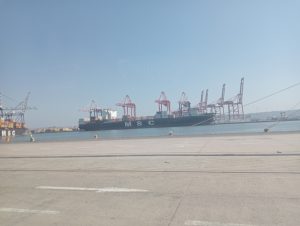
Shipping lines moving between Asia, Europe and the Americas are increasingly bypassing traditional routes and flowing around the Cape of Good Hope, driving a surge in vessel traffic along South Africa’s coastline. What was once treated as a costly detour is fast becoming a critical artery in global trade.
For supply chain professionals, the implication is clear: route selection is no longer just about distance – it is about reliability, cost certainty and risk. And right now, those factors are reshaping global logistics decisions.
From disruption to rerouting
Recent instability in key maritime corridors has sharply reduced traffic through traditional routes such as the Suez Canal. Shipping volumes through the Red Sea, for example, remain significantly below pre-disruption levels, with operators repeatedly suspending services due to risk and uncertainty.
At the same time, insurance markets – often the unseen arbiters of global trade – have repriced risk dramatically. In some cases, the cost of insuring a single transit through high-risk zones has exceeded the additional fuel and time required to reroute vessels around Africa.
As a result, traffic around the Cape has surged, with diverted vessel volumes more than doubling in a short period. Fuel demand at ports has jumped, and logistics operators are already feeling the pressure of increased throughput.
This is not just a temporary spike – it is a live stress test of South Africa’s supply chain infrastructure. A critical shift is underway in how global shipping lines and insurers evaluate routes. The priority is no longer the shortest path, but the most predictable and controllable one.
That means:
- Reliable port turnaround times
- Transparent and stable pricing
- Consistent bunkering (marine fuel) availability
- Clear visibility on delays, congestion and incident response
In supply chain terms, this is about end-to-end certainty – the ability to model, price and manage risk across the entire journey. South Africa sits directly on this emerging corridor. But geography alone is not enough.
The bottleneck is not the ocean – it is the ports
Despite its strategic position, South Africa’s logistics system remains under strain. Key ports – including Durban, Ngqura and Cape Town – rank poorly in global performance benchmarks, reflecting:
- Ageing infrastructure
- Equipment and maintenance backlogs
- Operational inefficiencies
- Administrative and procurement delays
These are not abstract issues; they have immediate, tangible consequences. They lead to longer vessel waiting times, drive up costs for shipping lines, undermine schedule reliability, and ultimately introduce greater volatility across the entire supply chain. And in global logistics, volatility is the one thing operators will pay to avoid.
The pressure is not limited to ports. South Africa’s broader logistics system – heavily reliant on road transport – is already vulnerable to disruption.
Inefficiencies compound across the chain:
- Congested port terminals slow inland distribution
- Weak rail integration increases road dependency
- Limited bunkering capacity constrains maritime services
- Poor data visibility reduces responsiveness
As supply chain experts consistently point out, even small inefficiencies multiply rapidly at scale, eroding margins and reliability. In this context, the surge in Cape traffic is both an opportunity and a warning: the system is being tested under real demand conditions.
Turning a detour into a supply chain corridor
For the Cape route to become a preferred global corridor – rather than a temporary workaround – South Africa needs to compete on supply chain performance, not just location.
That means focusing on the fundamentals:
- Infrastructure investment: Upgrades to port capacity, fuel storage and handling systems are needed to support sustained volume growth.
- Port efficiency: Faster turnaround times, reliable equipment and streamlined operations are essential to reduce delays and costs.
- Data and visibility: Real-time tracking, shared information systems and transparent performance metrics enable better decision-making across the chain.
- Integrated logistics: Stronger rail-port connections and inland distribution networks can ease congestion and improve flow.
- Risk management credibility: Clear compliance, monitoring and reporting systems help insurers and operators price risk more accurately – and favourably.
If these elements are addressed, the upside is significant. A well-functioning Cape Corridor would do far more than ease shipping flows; it could anchor new logistics and bunkering industries, draw investment into port and industrial infrastructure, create skilled employment across the maritime and logistics sectors, and ultimately strengthen South Africa’s position within global trade networks.
More importantly, it would shift the country from being a passive waypoint to an active supply chain hub.
The real test
Global supply chains are being reconfigured – not in theory, but in practice. Shipping lines are already making route decisions based on real-world performance, not policy promises. Insurers are already pricing risk based on operational data, not strategic intent.
The question is whether South Africa’s ports and logistics systems can deliver the consistency, efficiency and transparency required to turn this moment into a lasting advantage.
Because in modern supply chains, opportunity does not wait – it reroutes.
© RACA Journal